Kung fu - 4 kg right-arm payload
In these example runs, A-RMA and SH lose stability early. LSH balances longer, but for less time than our method and with poorer motion quality, as the slow-motion overlay shows.
We train a single humanoid policy for balancing motions with unknown hand payloads, using future-observation prediction to learn its history representation.
Achieving versatile humanoid control requires a single policy that can execute many diverse motions while remaining robust to unobserved environment conditions, such as payloads carried in the robot's hands. Each of these requirements is demanding on its own, and combining them compounds the difficulty: the same policy must represent motions with very different dynamics and, for each of them, infer conditions it never observes directly. A common way to achieve such robustness in reinforcement learning is to condition the policy on a long history of observations, encoded by a history encoder trained end-to-end. We show that this history encoder can be trained more effectively with an auxiliary future-observation prediction objective, derived from intention-conditioned flow occupancy models, which treats each motion-payload combination as a latent intention to be inferred from history. The prediction objective is optimized online from a replay buffer of recent trajectories, alongside standard PPO. We evaluate on a challenging benchmark of dynamic whole-body balancing motions with unknown hand payloads on a full-size Unitree H1-2. Our method improves normalized return over A-RMA and long-short-history baselines in simulation, and increases single-leg balancing time under load on hardware.
A history encoder infers the motion and payload conditions from past observations. The policy uses this representation to track the reference motion.
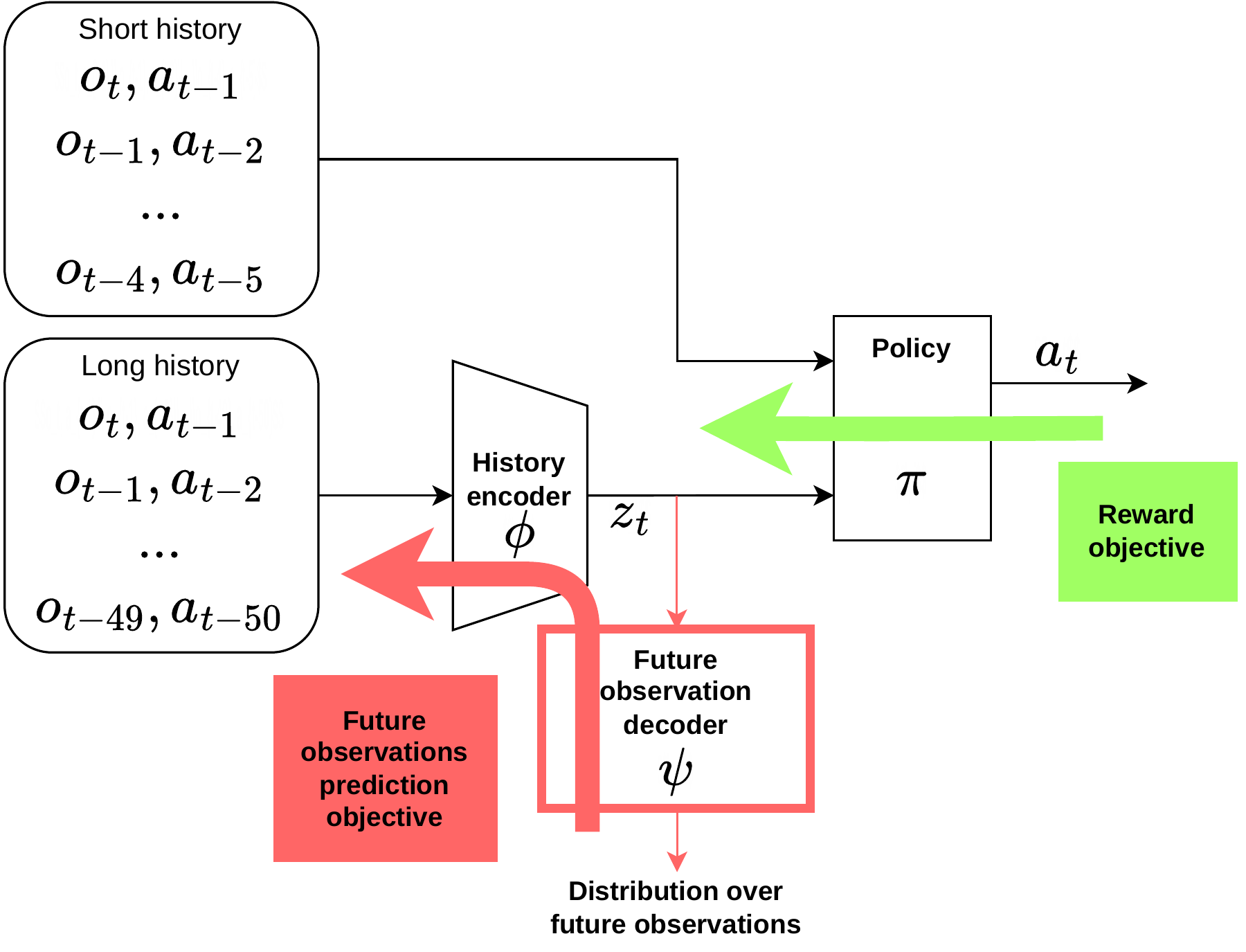
The prediction objective trains the history encoder; PPO trains the policy.
The videos show example runs.
In these example runs, A-RMA and SH lose stability early. LSH balances longer, but for less time than our method and with poorer motion quality, as the slow-motion overlay shows.
Without payload, all methods show similar balancing performance in these example runs.
LSH tracks the reference motions less closely, particularly the hand movements.
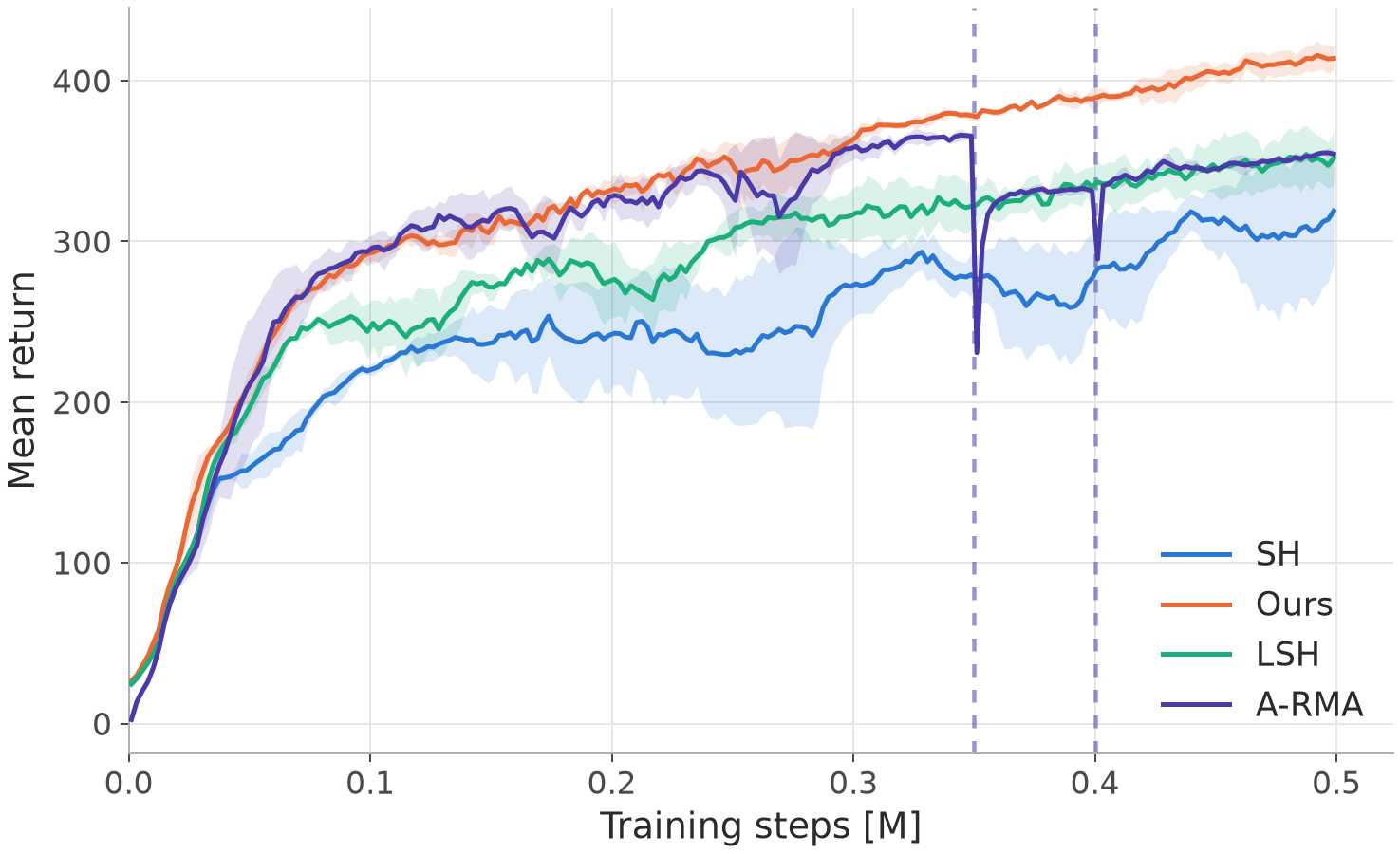
All methods train for 500k steps. Our method achieves the highest final training return, with low variance across seeds.
Evaluation uses 20 s episodes with full domain randomization and unknown payloads of 0-6 kg per hand. Our method achieves the highest return on all three motions.
| Motion | Ours | LSH | A-RMA | SH |
|---|---|---|---|---|
| Kung fu | 562.98 +/- 10.56 | 492.76 +/- 12.25 | 514.63 +/- 2.17 | 470.74 +/- 9.78 |
| Pistol squat | 518.59 +/- 14.21 | 423.49 +/- 8.36 | 425.02 +/- 2.92 | 404.61 +/- 28.41 |
| Squat | 579.43 +/- 12.76 | 479.51 +/- 27.94 | 522.42 +/- 2.23 | 500.64 +/- 11.01 |
| Normalized mean | 1.00 +/- 0.02 | 0.84 +/- 0.03 | 0.88 +/- <0.01 | 0.83 +/- 0.03 |
Surprisingly, prediction learns a history representation better suited to the task than PPO-only training, despite the dense, DeepMimic-style tracking rewards.
The latent is a compact encoding of recent observations and actions. We train the encoder online so that a decoder can use this latent to predict future observations from recent trajectories. This encourages it to retain information about both the motion and the hidden payload conditions. LSH learns its encoding through the policy gradient; A-RMA learns to match a teacher's encoding of privileged dynamics parameters.
Our history encoder has the same architecture as A-RMA's and is larger than the standard LSH encoder: it adds an MLP after the CNN. Giving LSH the same larger encoder and training it with PPO alone reduces performance. The prediction objective makes this additional capacity useful.
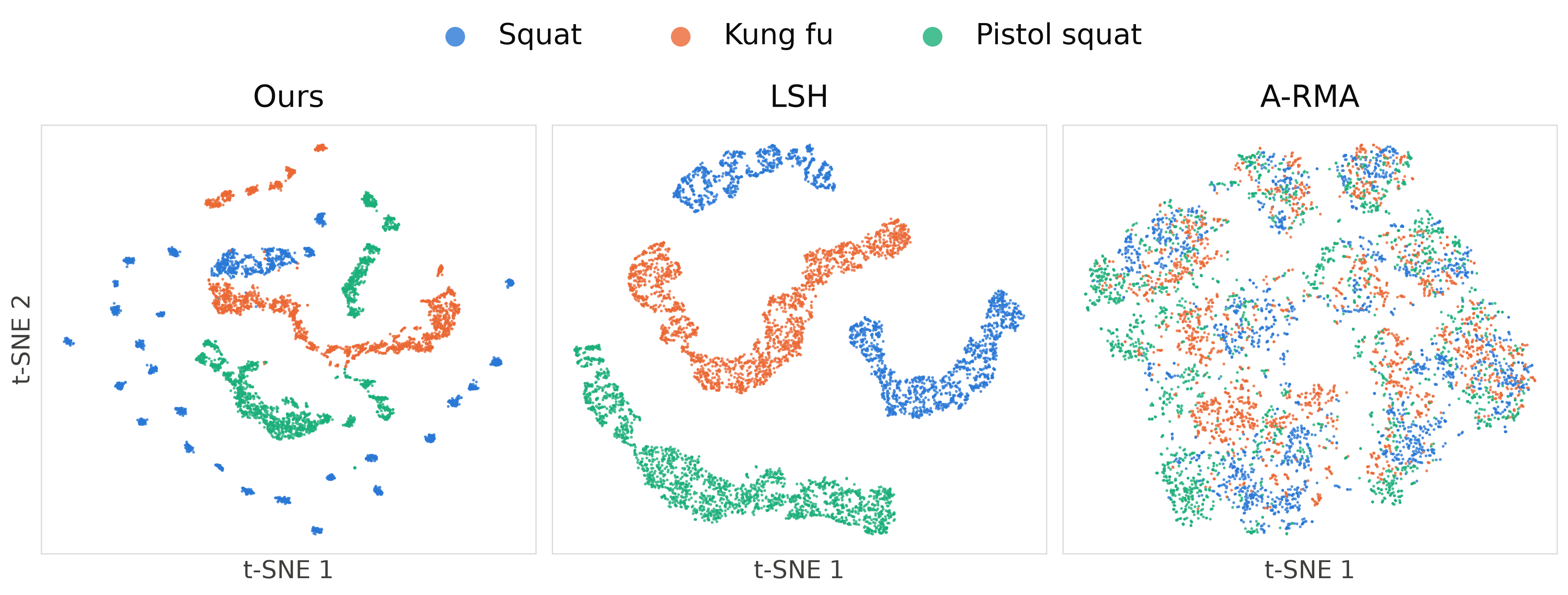
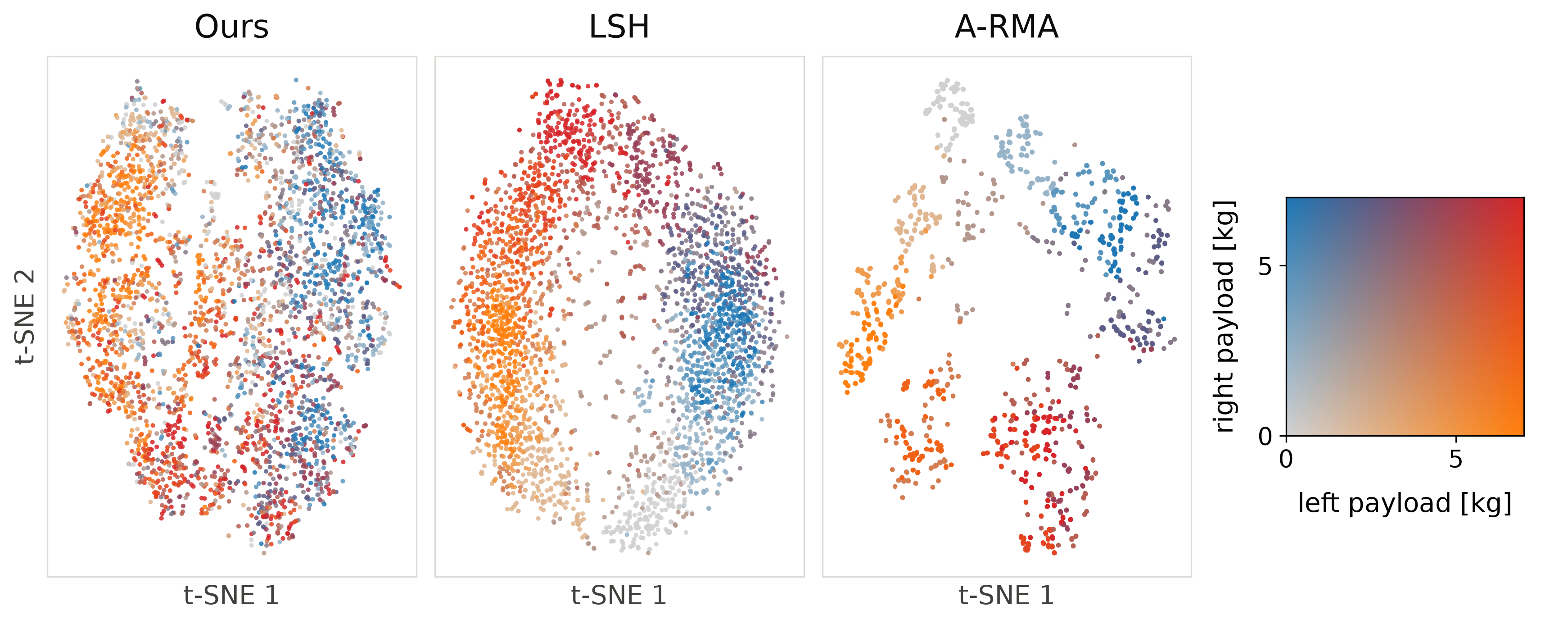
We collect the history encoders' outputs during simulation and project them into two dimensions with t-SNE. Coloring these projections by motion or payload shows what information the learned representations retain: all history-based methods encode payload information, while our method and LSH also show organization by motion. A-RMA's motion representations are more mixed.
@inproceedings{mstepien2026pao,
  title={Predictive Auxiliary Objective for Payload-Adaptive Multi-Motion Humanoid Balancing},
  author={Stępień, Maciej and Roux, Constant and Stasse, Olivier},
  booktitle={2026 IEEE-RAS 25th International Conference on Humanoid Robots (Humanoids)},
  year={2026}
}